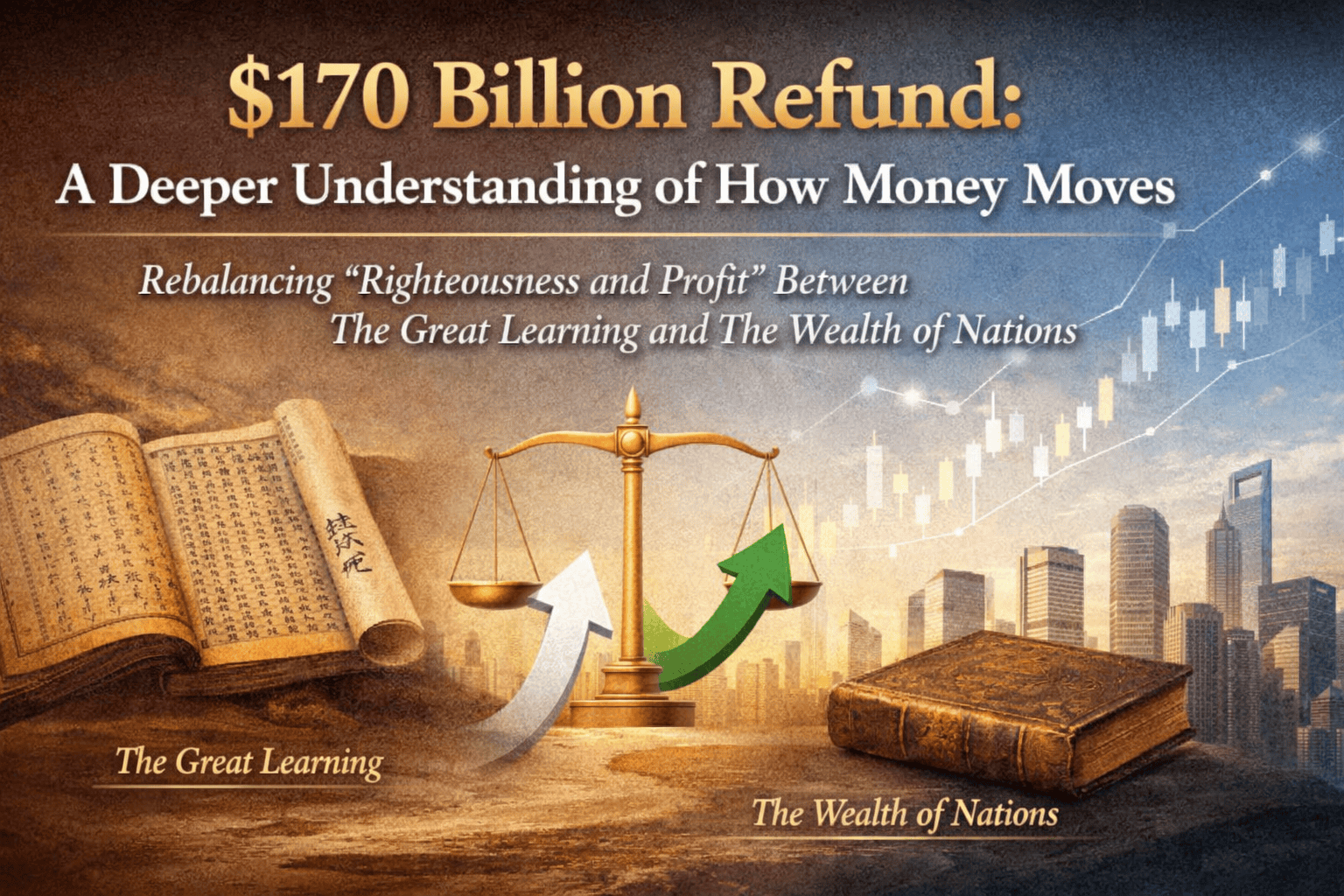
If we only look at this $170 billion tariff refund as just money, it’s easy to misunderstand it.
In 2026, after a Supreme Court ruling that previous tariffs were unlawful, the U.S. started refunding about $170 billion to around 330,000 importers, covering over 53 million customs entries. This money will return to businesses in a relatively short time.
Many people think this is just economic stimulus. But that view only stays at the level of “profit.”
The real question is deeper:
Why was the money taken in the first place? Why is it being returned? And when it goes back into the market, will it create new wealth—or just temporary movement?
Over 2,000 years ago, The Great Learning already explained this:
“There is a proper way to generate wealth:
let many create it, few consume it, and let it circulate quickly—then wealth will always be sufficient.”
This is not just about making money. It’s about the order of wealth—how it is created, distributed, and circulated.
This $170 billion has gone through all three stages:
- When tariffs were imposed, wealth creation was restricted.
- When money was collected by the government, resources became concentrated.
- Now, with refunds, the system is reopening and money can flow again.
But flow does not automatically mean effectiveness.
In The Wealth of Nations, Adam Smith explained that people naturally pursue profit, and the market uses that to allocate resources. So when this $170 billion returns to businesses, it will spread naturally: some will improve cash flow, some will reduce costs, others will invest.
But Smith didn’t fully address one thing:
The market can improve efficiency, but it does not guarantee the right direction.
If companies only use this money to fix the past instead of moving forward, then the money becomes stagnant—like a pool, not a river.
This is where The Great Learning adds something important. It doesn’t reject profit, but says profit must follow the “right way”:
- “Let many create” — more participants in value creation
- “Let few consume” — avoid excessive concentration
- “Let it circulate quickly” — money must move into real transactions and production
If the money just sits in accounts, it has been “returned,” but it has not truly created value.
Even understanding this is not enough. The biggest risk in reality is not ignorance, but going against the trend.
This is where Daoist thinking completes the picture. Laozi said “follow the natural way.” It doesn’t mean doing nothing—it means not fighting the overall direction.
Tariffs were a strong intervention. This refund is a kind of “release,” allowing the system to return to natural flow.
If businesses receive this money but make decisions against the market trend—like expanding when demand is shrinking, or holding onto outdated models—they may increase risk instead of creating value.
So when we combine Confucian, Daoist, and economic thinking, it forms a complete path:
- Profit (“li”) is the starting point — the driving force
- The “Way” (“dao”) provides structure and discipline
- Following the trend (“shi”) determines the outcome
Miss any one of these, and problems arise:
- Profit without structure leads to imbalance
- Structure without profit leads to stagnation
- Ignoring the trend cancels out effort
Back to reality: this $170 billion will not be evenly distributed, nor will it automatically create growth.
It is more like a mirror:
- Those who are prepared will receive it faster
- Those who understand the rules will receive more
- Those with vision will use it more effectively
Those who treat it as “unexpected money” may fall behind again in the next cycle.
So in the end, this is not just about refunds.
It is a lesson about how wealth truly works.
The Great Learning tells us: wealth is not scarce—what’s scarce is the right path.
The Wealth of Nations tells us: markets move—but direction depends on choice.
Daoism reminds us: true mastery is not force, but alignment.
This $170 billion will not decide who wins.
It will only amplify who truly understands how money should move.
Note: The text below is the original Chinese article. The translation above was generated with the help of ChatGPT.
1700亿退税:在“义、利、势”之间,看一场真正的经济修行
这1700亿的关税退还,如果只当成一笔钱,其实很容易看错。2026年,美国因最高法院裁定此前关税征收违法,启动对约33万进口商、超过5300万笔报关记录的退款流程,规模高达1700亿美元,这笔钱将在短时间内回到企业账户之中 。很多人第一反应是,这是一次“放水”,一次对经济的刺激,但如果只看到这里,其实只是停在“利”的层面。 真正值得思考的是,这笔钱为什么会被收走,又为什么要退回来,以及它回到市场之后,会不会变成新的财富,还是只是短暂的数字波动。
两千多年前,大学中已经把这个问题讲透了:“生财有大道,生之者众,食之者寡,用之者疾,则财恒足矣。”这句话的核心,并不是简单讲赚钱,而是在讲财富的秩序——财富如何产生,如何分配,又如何流动。今天这1700亿,其实正好完整走了一遍这三件事:当关税被加征的时候,是在改变“生”的方式,让财富在产生端被压缩;当资金被政府收走,是在改变“食”的结构,让一部分资源集中;而当今天开始退还,本质上是在重新打开“用”的通道,让钱重新流动起来。 问题在于,流动,并不等于有效。
亚当·斯密在国富论中讲,人是逐利的,市场会通过这种逐利形成资源配置。从这个角度看,1700亿回到企业手中,本来就会自然分散:有人补现金流,有人降成本,有人扩大采购,这些都不需要设计,是“利”本身的力量。但斯密没有说的一点是,市场可以决定效率,却不保证方向正确。如果所有人都只是在修补过去,而没有进入新的流动,这笔钱就会变成一潭水,而不是一条河。
这正是《大学》要补上的部分。它并不否定逐利,而是要求“利”必须在“道”之中。所谓“生之者众”,不是让一个环节赚钱,而是让更多环节参与创造;“食之者寡”,不是压缩利润,而是避免过度集中;“用之者疾”,更关键——钱必须流动,而且要快,要进入真实的交易与再生产。换句话说,这1700亿如果只是停在企业账上,是“退了”,但没有“生”;只有当它进入采购、进入供应链、进入价格体系,才真正完成它的使命。
但即使理解了这一层,还是不够,因为现实世界中最大的风险,从来不是“不懂道理”,而是“逆势而动”。这时候,道家的视角才真正把这件事情闭合。老子讲“道法自然”,意思不是消极,而是不要用人的意志去对抗整体趋势。关税的加征,本身是一种强干预,而今天的退税,其实是在“放手”,让系统恢复本来的流动。如果在这样的节点上,企业拿到钱却去做与市场方向相反的决策——比如需求在收缩却盲目扩张,结构在变化却固守旧模式——那这笔钱不仅不会创造价值,反而可能放大风险。
所以把儒、道、经济真正合在一起,其实不是三套理论,而是一条完整的路径:人以“利”为起点,这是动力;用“道”来约束,这是秩序;顺“势”去运行,这是结果。缺了任何一个,都会出问题——只有利,没有道,会失衡;只有道,没有利,不会动;不顺势,再多努力也会被抵消。
回到今天的现实,1700亿不会平均分给所有人,也不会自动变成经济增长。它更像一面镜子:有准备的人,会更快拿到;懂规则的人,会拿得更完整;看得远的人,会把这笔钱重新投入到更有效的地方。而那些只是把它当成“意外之财”的企业,很可能在下一轮周期里,再次被动承受变化。 所以,这件事情的本质,从来不是“退税”,而是一次关于财富如何运行的再教育。《大学》早就说清楚了,财富从来不缺,缺的是路径;《国富论》说,市场会动,但方向要靠选择;而道家提醒,真正的高手,不是用力,而是顺势。
这1700亿,最后不会决定谁赢,它只会放大——谁真正理解了钱该怎么走。